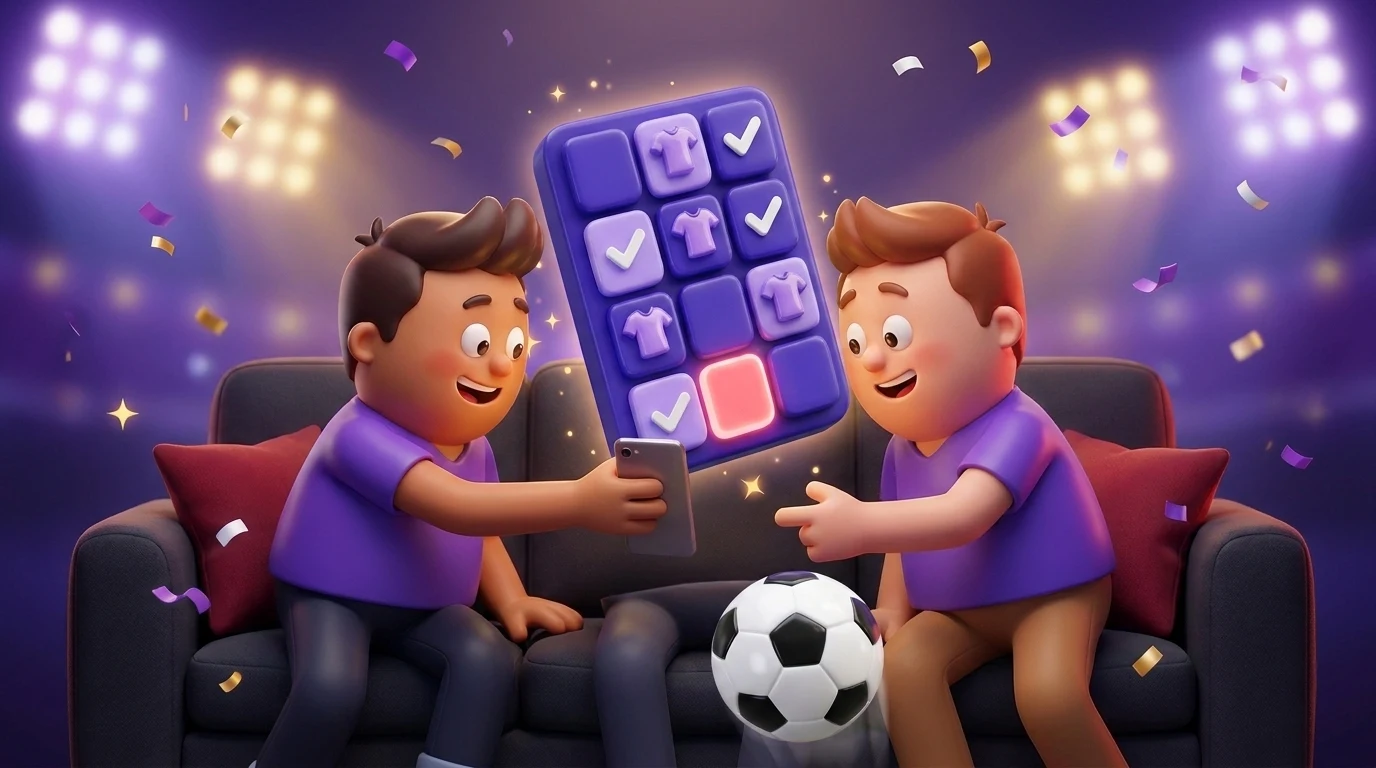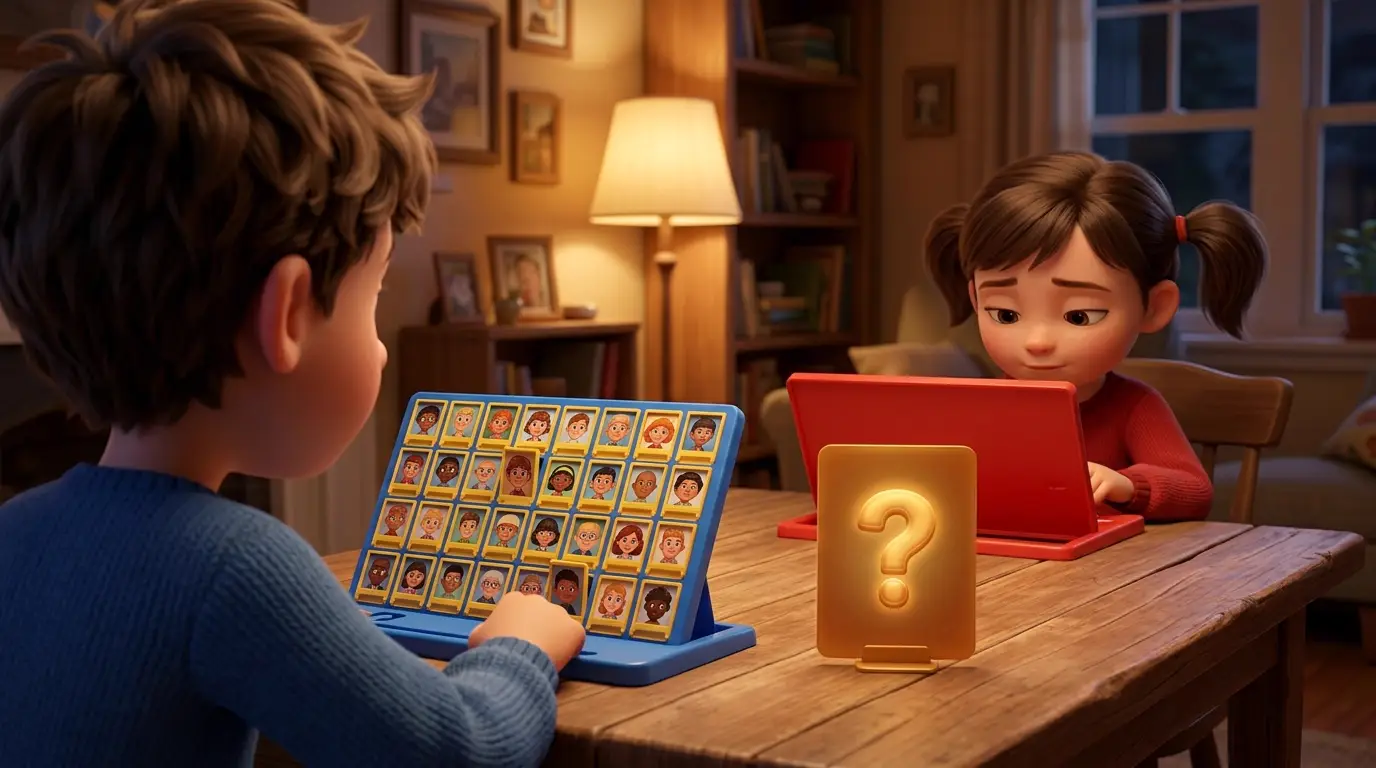
Guess Who is a game for two players. Each of you secretly picks one face from a board of 24, and you take turns asking yes or no questions to work out which face your opponent chose. Flip down every face the answer rules out, and the first player to name the other's character wins.
The rules fit in one minute. Winning takes longer, because the whole game hides in one skill: asking questions that remove as many faces as possible. This guide gives you the rules, more than 30 questions that work, a strategy built on simple counting, and a way to play Guess Who online free with a friend. The examples come from the four boards in our own game, so every trait mentioned is something you can actually see on a face.
What is Guess Who?
Guess Who is a face guessing game for two people, usually played on a tabletop board with rows of flip-down portraits. Both players look at the same set of faces. Each player also holds one secret character card that the other cannot see.
Your goal is to find the secret character on your opponent's card before they find yours. You cannot ask "Is it Maya?" on turn one and expect to win. You narrow the field with questions about what you can see: hair, glasses, hats, beards, colors.
| Part of the game | Standard setup |
|---|---|
| Players | 2 |
| Board | 24 faces, all visible to both players |
| Secret card | 1 per player, hidden from the other |
| On your turn | Ask 1 yes or no question, or make 1 guess |
| Win | Name the other player's character correctly |
| Typical length | 5 to 10 minutes |
How to play Guess Who, step by step

- Set up the board. Both players see the same 24 faces, all standing up.
- Pick secret characters. Each player gets one character at random. Look at yours and keep it hidden. Your opponent is trying to find this face.
- Choose who starts. Flip a coin or let the younger player go first. In a rematch, the player who went second starts.
- Ask one yes or no question. On your turn, ask something the other player can answer with a plain yes or no, like "Does your person wear glasses?"
- Answer honestly. The whole game depends on honest answers. One wrong answer ruins the round for both of you.
- Flip the faces that no longer fit. If the answer was yes, flip down everyone without glasses. If it was no, flip down everyone with glasses. You flip only on your own board, so your opponent never sees which faces you cleared.
- End your turn. Now your opponent asks a question about your character, and you answer.
- Make a guess when you are ready. Instead of a question, you can name one character. If you are right, you win. If you are wrong, you lose the round.
- Play again. Swap who starts, pick new secret characters and keep score.
Two details cause most arguments at home. First, on a turn you either ask or guess, never both. Second, a wrong guess is an immediate loss, so guessing with three faces still standing is a gamble, not a plan.
Good questions and bad questions
A good Guess Who question does two things: anyone can answer it with yes or no, and it splits the faces that are still standing into two groups of similar size.
Good questions are about something visible. "Does your person have a beard?" works because everyone agrees on what a beard is. Bad questions are fuzzy. "Does your person look friendly?" or "Is your person young?" start fights, because two people can see the same face differently.
Good questions cover a group. "Does your person have dark hair?" can remove a large share of the board. Weak early questions chase one face. "Is your person called Ben?" removes a single face on a no. Save that for the last turn.
| Question | Verdict | Why |
|---|---|---|
| Does your person wear glasses? | Good | Clear, visible, and splits many boards close to half |
| Is it a woman? | Good | Splits our classic board exactly 12 and 12 |
| Does your person look nice? | Bad | An opinion, not a fact |
| Is your person's name Leo? | Weak early | Removes only one face if the answer is no |
| Do they have a beard or a hat? | Avoid | Two questions in one, so a yes tells you almost nothing |
| Is the hair brown, black or red? | Avoid | Not a yes or no question |
30+ best Guess Who questions
These questions come straight from the four boards in our game. Each board has 24 original characters, and each question matches a trait you can see on the faces. The number in brackets shows how many of the 24 faces fit, so you can see which questions split the board best.
Classic faces

- Is it a woman? (12 of 24, a perfect first question)
- Is your person wearing glasses? (9)
- Is your person wearing a hat? (8)
- Does your person have a mustache? (8)
- Does your person have long hair? (8)
- Does your person have curly hair? (6)
- Does your person have black hair? (6)
- Is your person wearing earrings? (5)
- Does your person have a beard? (5)
- Does your person have brown hair? (5)
- Does your person have blonde hair? (4)
- Is your person bald? (3)
- Does your person have red hair? (3) Or white hair? (3)
Football stars
Players on this board are told apart by shirt color, hair and role.
- Does your player have a beard? (8, the best splitter on this board)
- Is the shirt striped? (5)
- Does your player have blonde hair? (5)
- Does your player have long hair? (5)
- Is your player a goalkeeper? (4)
- Is your player wearing a headband? (4)
- Is your player bald? (4)
- Is your player wearing a red shirt? (4, and the same count for blue, white, yellow, green and black)
Animals
- Can it fly? (7)
- Is it wearing glasses? (6)
- Is it wearing a hat? (6)
- Is it wearing a bow tie? (6)
- Does it have feathers? (5)
- Does it have horns or antlers? (4)
- Does it have big ears? (4)
- Does it live in the sea? (4)
- Is it a common pet? (4)
- Is it a farm animal? (4)
- Does it have stripes? (3) Or spots? (3)
Monsters

- Does it have sharp fangs? (7)
- Is it furry? (6)
- Does it have horns? (6)
- Does it have spots? (6)
- Does it have only one eye? (5)
- Does it have antennae? (5)
- Does it have three eyes or more? (4)
- Does it have wings? (4)
- Is it purple? (4) Or green, blue, orange, pink or yellow? (4 each)
That is more than 40 questions, and the same thinking works on any set of faces, including a real board. Ask about the biggest visible groups first, then the smaller ones.
Guess Who strategy: halve the board
The best strategy is simple. Ask the question whose yes group and no group are closest in size. Whatever the answer, you flip about half of what is left.
With 24 faces and a perfect half split every turn, the board shrinks like this:
| After question | Faces left |
|---|---|
| Start | 24 |
| 1 | 12 |
| 2 | 6 |
| 3 | 3 |
| 4 | 2 |
| 5 | 1 |
Five clean questions can isolate one face out of 24. That is the theoretical best, and real boards rarely give you perfect halves, but it shows why one good question beats three mediocre ones. A question that clears 3 faces at best is a poor trade next to one that clears 12.
On the classic board, "Is it a woman?" splits 12 and 12. A question about red hair (3 faces) clears only 3 on a no and 21 on a yes, which is almost no information. On the football board, each shirt color covers just four faces, so a shirt question is weak early. "Does your player have a beard?" covers eight and is much stronger.
Re-count after every answer
The best question changes every turn. After "Is it a woman?" gets a yes, the 12 faces left are a different board, and glasses might now split them 5 and 7. Count the faces still standing before you ask, then pick the trait closest to half of that number.
When to risk a guess
Guess when only one face is standing. With two faces left, a guess wins half the time, so take it only if your opponent is close to winning and waiting would lose you the game anyway. With three or more faces, ask another question first. A wrong guess ends the round at once.
Read your opponent's questions
Their questions show how close they are. If they are still asking about big groups like hair color, they have many faces left. If they ask something narrow, like whether your person wears a hat and has curly hair, they are probably down to a handful. Count their questions too: after four or five good ones, you should expect a guess any turn now.
Variants and house rules
The base game works well as it is, but you can change the pace for different groups.
- Kids: Let younger players ask any question they like, and use boards with big, obvious differences, like our animals or monsters boards.
- Classroom: Use a board of people or things connected to a lesson. Pairs play while the others watch, then they swap.
- Party: Play as a bracket. Pairs play, winners move on, and the crowd votes on whether a question was fair.
- Speed rounds: Agree on a time limit for each question, such as 15 seconds. This is a house rule, and our online game has no timer, so use a phone clock or a spoken countdown if you want one.
- One free miss: Allow each player one wrong guess per round. It cuts the fear of guessing and speeds up the game.
- Best of three: Play three rounds and let the loser of the first round start the next.
Play Guess Who online free
You do not need a physical board. On Find the Imposter you can play Guess Who in your browser on a phone, tablet or computer, with no download and no account. Every character is original, drawn for this game.
There are three ways to play:
- Online with a friend. Create a room and share the link, the QR code or the six-digit room code. Your friend joins from their own device and each of you sees your own secret character. Type your question in the chat and your friend answers with the Yes and No buttons under your message. Then flip faces and end your turn. If a connection drops, you come back to the same match.
- Two players, one phone. Type both names and pass the phone. Each turn starts with a cover screen so nobody sees the other board. Ask your question out loud.
- Against the bot. Play alone against a bot in easy, normal or hard. Pick your questions from a list and use the button that flips every face that no longer fits. The bot answers honestly from its card.
You can choose from four boards: classic faces, football stars, animals and monsters. Each has 24 characters. There is no timer, so everyone thinks as long as they need, and you can stand a face back up if you tapped it by mistake. To start now, open the Guess Who game and pick a board.
If you like guessing games in general, try Spyfall for a bluffing game about a secret place, or Guess the Football Player for another two-player duel. For more ideas read our guide to two-player word games.
Guess Who FAQ
How do you play Guess Who?
Each player picks a secret character from a board of 24 faces. You take turns asking yes or no questions about the other player's character and flip down the faces that no longer fit. The first player to name the other's character correctly wins.
What are the rules of Guess Who?
On your turn you either ask one yes or no question or make one guess. Answers must be honest. A wrong guess means you lose the round. Each player flips faces on their own board only.
What are the best Guess Who questions?
The best questions are about visible traits and split the remaining faces close to half. "Is it a woman?", "Are they wearing glasses?" and "Do they have a hat?" are strong openers on a classic board.
How do you win Guess Who every time?
You cannot win every time, because the secret character is random, but you win more by halving the board with each question and only guessing when one or two faces are left. Avoid questions about one rare detail early on.
Can you play Guess Who online with a friend for free?
Yes. On Find the Imposter you can create a free room, share the link or room code and play with a friend on any device. There is no download and no account.
Can you play Guess Who by yourself or on one phone?
Yes. You can pass one phone between two players or play against a bot in easy, normal or hard.
Is this the original Guess Who?
No. The characters, pictures and boards here are original. Guess Who? is a trademark of Hasbro, Inc., and this site is not affiliated with Hasbro.
Ready for your first round?
Pick a board, ask the question that splits the faces in half and keep counting. Play Guess Who online free and see how few questions you need.