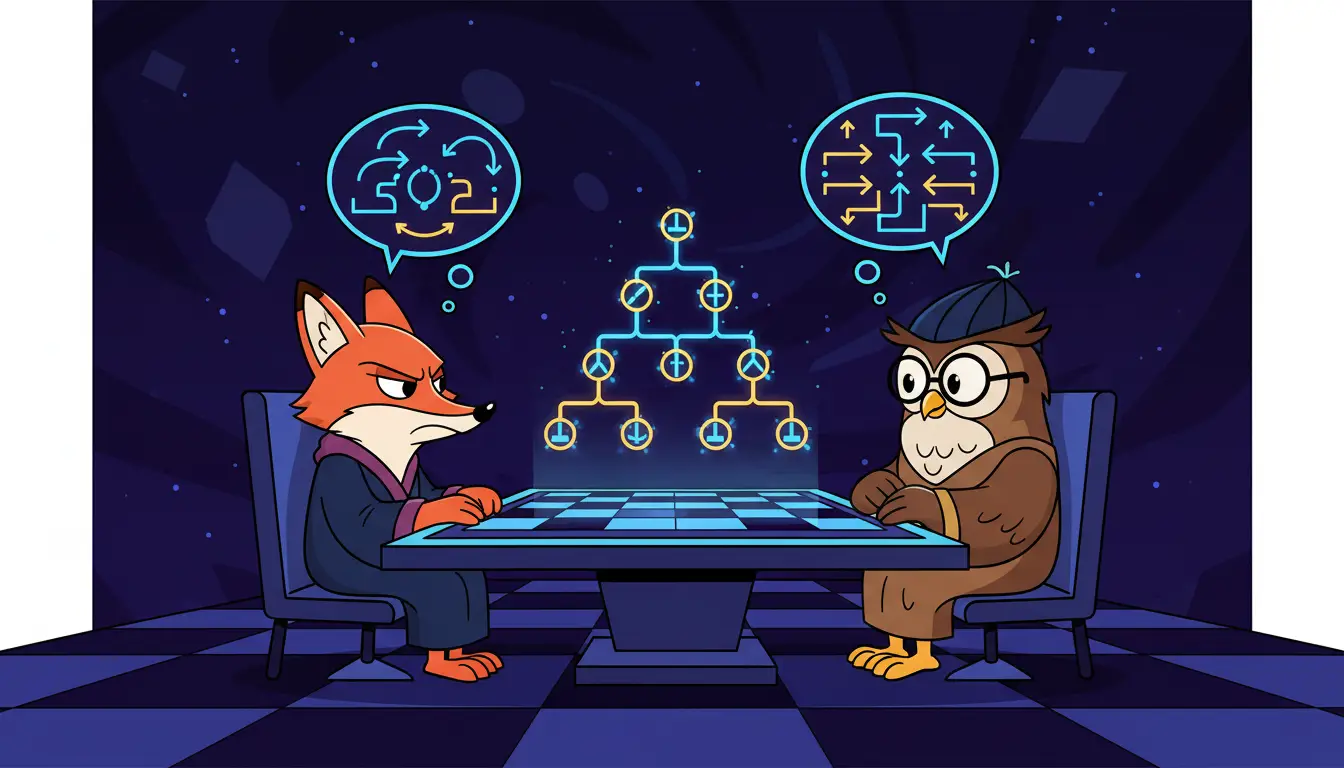
Every round of Find the Imposter is a game theory problem. Players choose strategies under uncertainty, with incomplete information, where optimal moves depend on what they believe others will do.
You don't need to know the math to play. But understanding it explains why certain strategies work, why bluffing has limits, and why experienced players consistently outperform new ones, even when luck distributes roles equally.
The Prisoner's Dilemma in Disguise
The classic game theory problem: two suspects are held separately. Each can stay silent or betray the other.
- Both silent → small punishment each
- One betrays, one silent → betrayer goes free, silent player gets maximum punishment
- Both betray → medium punishment each
The "rational" individual choice is always to betray. But if both do this, the collective outcome is worse than if both had cooperated.
In Find the Imposter: When multiple Impostors exist, each could subtly expose the other to deflect suspicion. But if both do this, they make each other easier to catch. Cooperation (giving consistent, plausible clues) produces better collective outcomes, but requires trusting each other not to defect.
Nash Equilibrium: Why Experienced Players Are Hard to Read
A Nash equilibrium is a set of strategies where no player can improve their outcome by unilaterally changing their own strategy.
In poker, the Nash equilibrium bluffing frequency is mathematically derivable, you bluff at exactly the rate that makes your opponent indifferent between calling and folding. Bluff too often and they always call. Too rarely and they always fold.
The same principle applies to imposter game clue strategy:
- Imposter always gives vague clues: Crewmates learn to vote for the vaguer players. Vague clues become a tell.
- Imposter always gives accurate clues: They're indistinguishable from crewmates, but accurate clues risk revealing the word.
The Nash equilibrium is a mixed strategy: clues of calibrated accuracy, not always vague or always accurate, in a distribution that keeps crewmates uncertain. Experienced Impostors naturally converge on this without calculating it consciously.
Bayesian Reasoning: Updating Beliefs Correctly
Bayesian inference is the mathematically correct method of updating beliefs given new evidence. It starts with a prior probability and adjusts it based on how likely the new evidence would be under each hypothesis.
In a game with 8 players and 1 Imposter, each player starts with a 1-in-8 chance (12.5%) of being the Imposter.
If a player gives a clue only someone who knows the word would plausibly give, their probability of being the Imposter drops significantly. If a player gives a clue that works equally well whether or not they know the word, their probability barely changes.
The error most players make: They don't update from the prior, they start from their suspicion and assign evidence to it. This is the inverse of Bayesian reasoning. Ask: "Given this clue, what's the probability this person is the Imposter?" Not: "Given my belief this person is the Imposter, how suspicious does this clue seem?"
Information Theory: The Optimal Clue
Entropy in information theory measures uncertainty. High entropy = high uncertainty.
An Imposter's optimal clue has calibrated entropy: low enough to seem credible (consistent with knowing the word), high enough that it doesn't reduce crewmates' uncertainty about the word.
- "It's... around us?" → very high entropy. Suspicious.
- "Cold, carbonated, refreshing" → very low entropy. Risks giving the word away.
- "Something you consume daily" → medium entropy. Plausible, not revealing. This is where experienced Impostors operate.
Why the First Vote is the Most Informative
Early votes, before players have updated their beliefs much, reveal the most about underlying private knowledge.
A first vote that comes quickly and confidently from a player signals either genuine certainty (crewmate with strong evidence) or calculated deflection (Imposter managing the early narrative).
A first vote that's hesitant and consensus-seeking usually signals a crewmate reasoning from limited information.
The Takeaway
Social deduction games are not luck. Beneath the fun is a structured reasoning problem: incomplete information, strategic interaction, Bayesian updating, and mixed strategy optimization.
Understanding the math doesn't make you better overnight. But it tells you exactly what to practice: unpredictability, Bayesian updating, and calibrated information release.