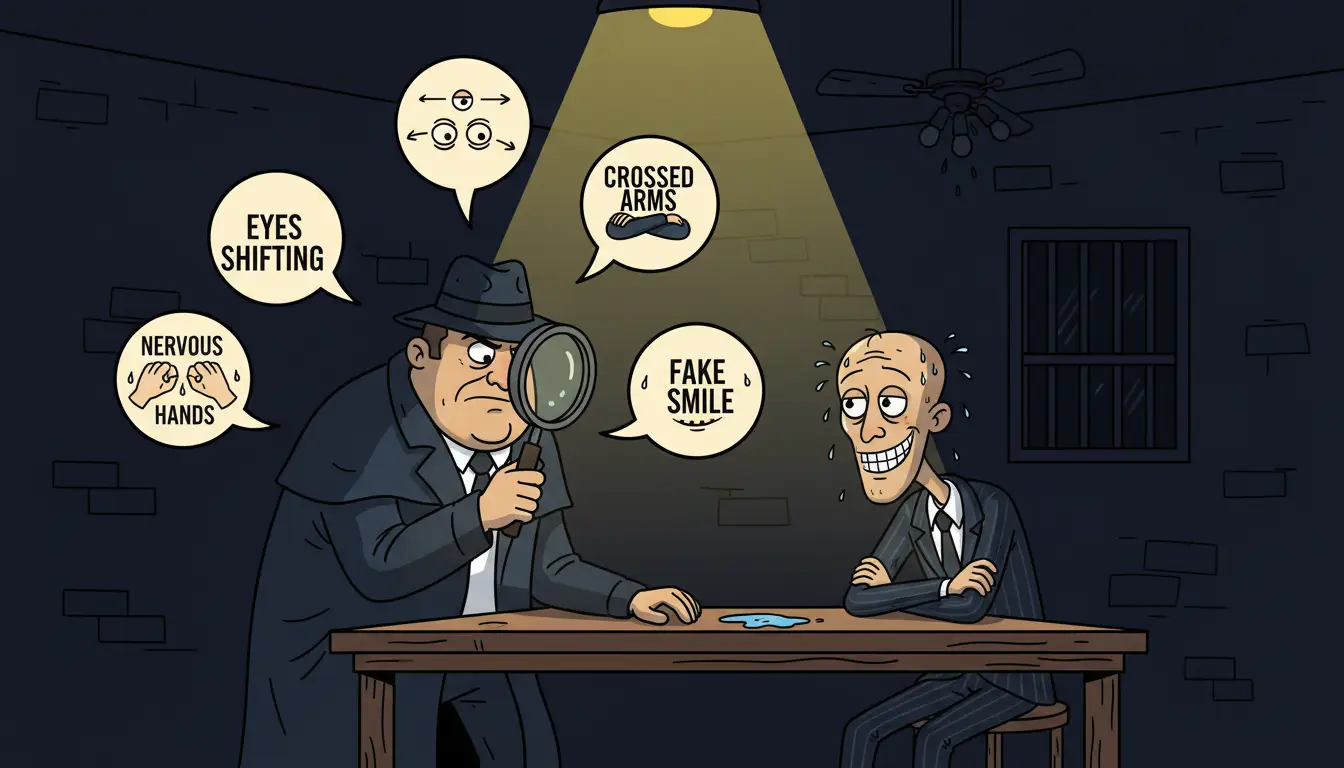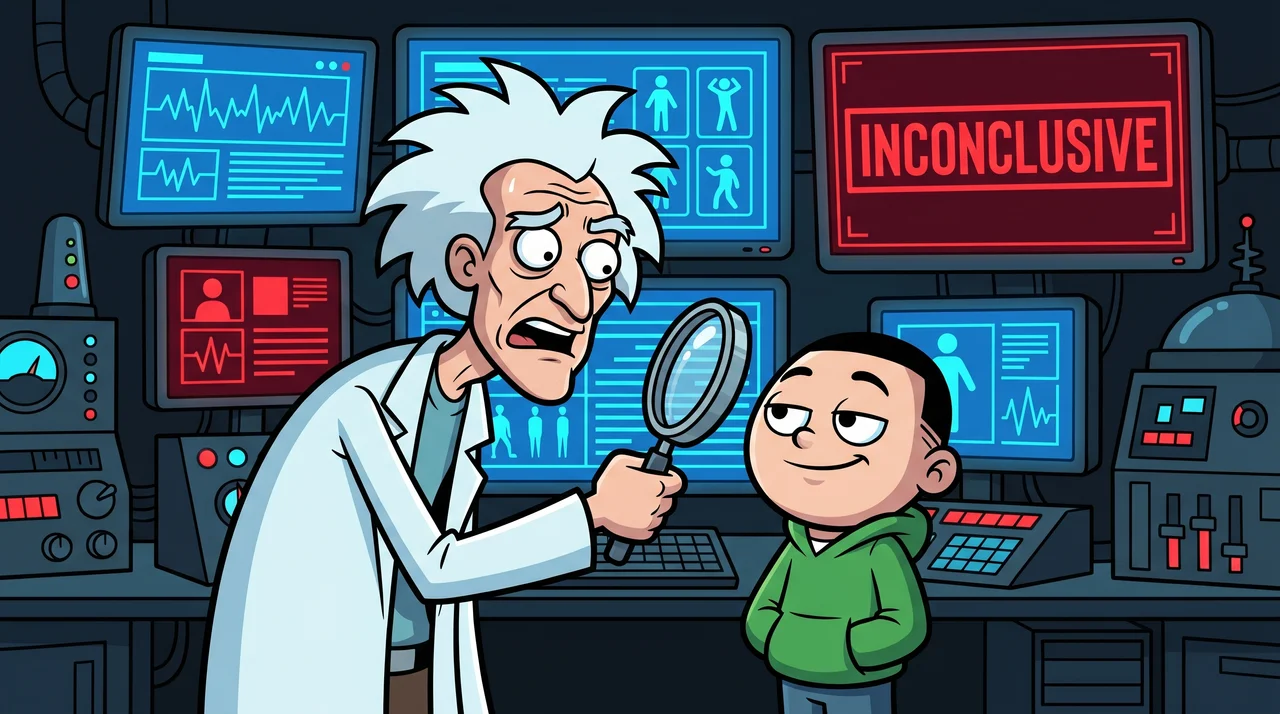
Ask most people how good they are at detecting lies and they'll say: pretty good. Ask them to actually do it in a controlled experiment and the truth is humbling. Research consistently shows that humans detect lies at roughly 54% accuracy, barely better than a coin flip. FBI agents, police detectives, and clinical psychologists perform no better than college students. Confidence in lie detection is high. Accuracy is not.
Here's what the science actually says.
The Myth of the Lying Tell
Popular culture has sold us a set of "tells", signs that someone is lying:
- They avoid eye contact
- They touch their face
- Their voice pitch rises
- They fidget or shift their weight
- They hesitate before answering
The problem? Every one of these has been studied in controlled conditions, and none reliably predict deception. The most comprehensive meta-analysis on behavioral deception cues (Vrij et al., 2019) examined over 200 studies and found that the cues most commonly cited by police trainers, gaze aversion, nervous movements, speech hesitation, showed near-zero correlation with actual lying.
Why? Because these behaviors correlate with anxiety, not deception. An innocent person being interrogated is anxious. A practiced liar is not. The behaviors you're trained to watch for flag the nervous innocent, not the confident liar.
Why We're Wired to Believe
Human communication evolved in small tribes where most interactions were with people you knew well, family, tribe members, long-term collaborators. In that context, the default assumption of honesty made evolutionary sense. Treating every communication as potentially deceptive would have been cognitively exhausting and socially corrosive.
We are not built for adversarial communication at scale. We are built for cooperative communication in trusted groups. The modern world, anonymous online interactions, negotiations with strangers, high-stakes professional settings, is not what our deception-detection circuitry was designed for.
What Actually Predicts Deception
If behavioral cues don't work, what does? Research points to a different approach entirely: content analysis over behavioral observation.
1. Statement Validity Analysis
Truthful accounts tend to be:
- Contextually embedded (include peripheral details that weren't asked for)
- Self-contradictory in minor ways (real memory is imperfect)
- Spontaneously corrected ("wait, I said 9pm, it was actually closer to 8:30")
Deceptive accounts tend to be:
- Overly polished and internally consistent
- Scripted-sounding, with the same level of detail at every point
- Missing emotional embedding (describing events without the associated feelings)
2. Cognitive Load
Lying is harder than telling the truth. A liar must construct a story, remember it, maintain consistency, and monitor your reaction simultaneously. When you increase cognitive load, ask unexpected questions, request the story in reverse order, ask for details about peripheral events, liars perform markedly worse than truth-tellers.
This is why skilled interviewers ask questions like "tell me everything that happened the hour before" rather than "tell me what you were doing at 10pm."
3. Baseline Comparison
The only behavioral cue that has any predictive validity is deviation from a person's established baseline. If someone who normally makes direct eye contact suddenly avoids it, that's signal. If someone who normally fidgets stops fidgeting when you ask a specific question, that's worth noting. But you need a baseline first, which requires extended observation.
The Confident Liar Problem
The most dangerous liars are not nervous, they're confident. Research on psychopathy (which is separate from violence, most psychopaths are non-violent) consistently finds that individuals with higher psychopathic traits are significantly better at deception. Not because they display fewer "tells," but because they experience reduced anxiety when lying. There's no cognitive dissonance to suppress. The physiological correlates of deception simply don't fire.
This means that the more confident and smooth someone seems, the worse your ability to detect deception becomes, because confidence was your primary unconscious signal.
Social Deduction as Training Ground
Games like Find The Imposter are, at their core, practical lie detection training. One player doesn't know the shared word and must construct plausible-sounding clues under pressure. Other players have to identify them.
The game forces you to develop exactly the skills that research suggests actually work:
- Content analysis: Is this clue too vague? Too perfectly calibrated? Does it feel scripted?
- Baseline deviation: This person usually gives specific clues. Why is this one suspiciously general?
- Cognitive load signals: Did they hesitate in the middle of a clue they should know?
Over dozens of rounds, you build intuitions about the difference between genuine uncertainty and performed uncertainty, skills that transfer to real-world reading of people.
The Practical Takeaway
You cannot reliably spot a liar from body language. The behaviors you've been trained to watch for are anxiety cues, not deception cues, and they flag the wrong people. What works instead:
- Focus on what people say, not how they say it
- Ask for peripheral details you didn't request
- Establish a behavioral baseline before assigning meaning to deviations
- Increase cognitive load, ask the question you didn't announce
And if you want low-stakes practice reading people for deception? Find The Imposter gives you dozens of repetitions in a single session, with immediate feedback. No experience required.
The human lie detector is a myth. But human pattern recognition, applied correctly, is not.