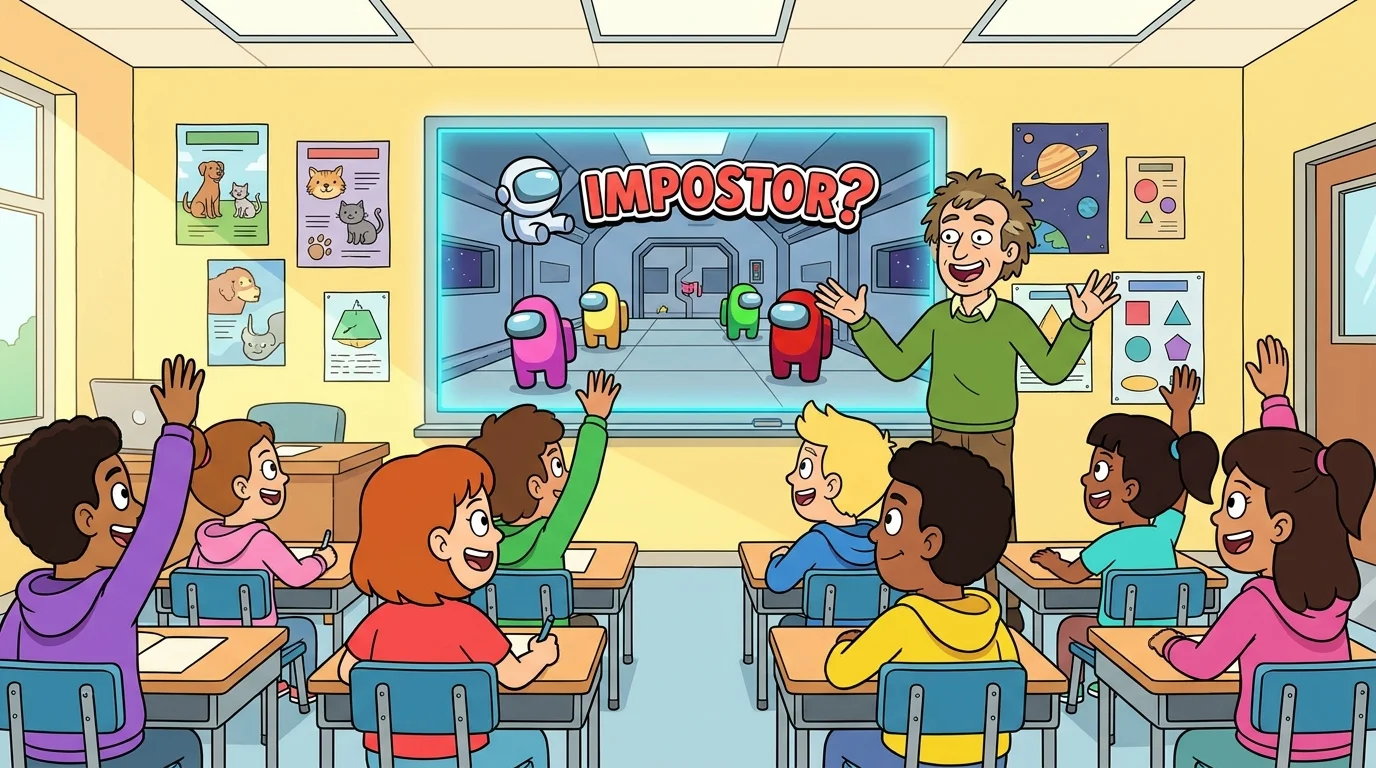
Looking for an imposter game that actually works for education? Find the Imposter has become a favorite among teachers worldwide for its ability to transform learning into an engaging, interactive experience.
Why Teachers Love Using the Imposter Game
The imposter game format is naturally perfect for education:
1. Active Learning
Unlike passive activities, an imposter game requires every student to:
- Listen carefully to peers
- Formulate thoughtful responses
- Analyze information critically
- Make evidence-based decisions
2. Low-Stakes Speaking Practice
For shy students, the game provides a comfortable framework for participation. They're not "presenting" - they're playing a game where everyone speaks.
3. Vocabulary Reinforcement
When students describe secret words without saying them directly, they practice:
- Synonyms and related terms
- Context clues
- Descriptive language
- Subject-specific vocabulary
Setting Up the Imposter Game for Your Class
Equipment Needed
- One device (phone, tablet, or computer)
- That's it! Find the Imposter is completely free and browser-based.
Optimal Class Sizes
- Small Groups (4-8): Perfect for intensive practice
- Medium Groups (8-15): Ideal balance of chaos and structure
- Large Groups (15-20): Maximum excitement, works great for rewards/breaks
Time Allocation
- Quick Round: 5-7 minutes (perfect for transitions)
- Full Session: 20-30 minutes (vocabulary review or Friday rewards)
- Extended Play: 45+ minutes (sub plans or celebration days)
Subject-Specific Implementation Ideas
English Language Arts
Category: Vocabulary, Literary Terms, Authors Learning Objective: Reinforce vocabulary through contextual description
Example Round:
- Secret word: "Metaphor"
- Students describe without saying "figure of speech" or "comparison"
- The imposter must blend in while learning from context clues
Science
Category: Science, Animals, Nature Learning Objective: Practice scientific vocabulary and classification
Example Round:
- Secret word: "Photosynthesis"
- Students describe the process, components, or outcomes
- Great for reviewing unit vocabulary before tests
Social Studies
Category: Countries & Cities, History, Famous People Learning Objective: Reinforce geographic and historical knowledge
Example Round:
- Secret word: "Ancient Egypt"
- Students give clues about culture, geography, or timeline
- Imposters reveal knowledge gaps that teachers can address
World Languages / ESL
Category: Any (in target language) Learning Objective: Immersive vocabulary practice
The imposter game format is exceptional for language learning because:
- Students MUST use the target language to survive
- Imposters learn new vocabulary through context
- Speaking feels natural, not forced
Math
Category: Custom (create your own) Learning Objective: Math vocabulary and concept recognition
Example Round:
- Secret word: "Quadratic Equation"
- Students describe properties, graphs, or applications
- Reinforces mathematical language
Classroom Management Tips
Establishing Expectations
Before your first imposter game session:
- Set the tone: "This is a learning game, not just fun time"
- Model good behavior: Play a round as a participant first
- Establish consequences: Disruptive behavior = sitting out next round
Managing Noise Levels
The game naturally gets loud during voting. Try:
- Quiet voices signal: When raised, discussions must be whispered
- Timer visibility: Display remaining time to pace discussions
- Designated speaker: One person talks at a time during formal debate
Ensuring Participation
- Rotate who goes first: Don't let confident students dominate
- Require evidence: "You voted for Maya - explain why"
- Celebrate good plays: Recognize clever descriptions AND good detective work
Assessment Opportunities
Informal Assessment
The imposter game reveals student understanding naturally:
- Who struggles to describe key vocabulary?
- Which concepts need re-teaching?
- Who demonstrates mastery through creative descriptions?
Formal Integration
- Exit tickets: "Write the secret word from Round 3 and define it"
- Reflection journals: "What new word did you learn as the imposter?"
- Vocabulary tests: Include words used in recent game sessions
Real Teacher Success Stories
Elementary School (3rd Grade)
Middle School (6th Grade Science)
"The imposter game transformed my unit reviews. Students are actually excited to study vocabulary because they know it helps them win." - Mr. Patel, California
High School (AP History)
"I was skeptical, but the level of historical discourse during the game impressed me. Students were debating the causes of WWI with more nuance than my lectures." - Ms. Rodriguez, Florida
ESL Classroom
"My English learners went from refusing to speak to arguing passionately about who the imposter was. The game removes the fear of making mistakes." - Mr. Kim, New York
Common Concerns Addressed
"Won't this be too distracting?"
Proper setup prevents chaos. The game has natural structure - turns, timers, and voting - that maintains order.
"What about the curriculum?"
The imposter game IS curriculum when you choose educational categories. It's gamified vocabulary practice, not off-topic entertainment.
"Some students will dominate"
The turn-based structure ensures everyone speaks. Imposters who stay quiet get caught - the game rewards participation.
"What if students cheat?"
The pass-and-play mechanic means only one person sees their role at a time. No phones needed for students.
Making It Even More Educational
Pre-Game Prep
- Have students create word lists for custom categories
- Review vocabulary before playing (preview, don't spoil)
- Connect to current unit themes
Post-Game Discussion
- "What descriptions were most helpful?"
- "How did the imposter almost fool us?"
- "Which words were hardest to describe? Why?"
Extension Activities
- Writing: Create short stories using 5 secret words from today
- Presentation: Explain your favorite round to another class
- Research: Deep dive into a word that stumped you
Getting Started Today
Ready to bring the imposter game to your classroom?
- Visit findtheimposter.com on any device
- Select an educational category
- Add student names (or numbers for privacy)
- Start the first round!
No accounts, no downloads, no cost. Just engaging, educational fun that students will actually request.
Conclusion
The imposter game format offers something rare in education: learning disguised as play. Find the Imposter makes this accessible to every teacher with zero budget and minimal setup.
Your students will practice vocabulary, develop critical thinking, and engage with content - all while having genuine fun. That's the power of game-based learning done right.
Start Your First Classroom Game and watch engagement soar!
Related Articles: