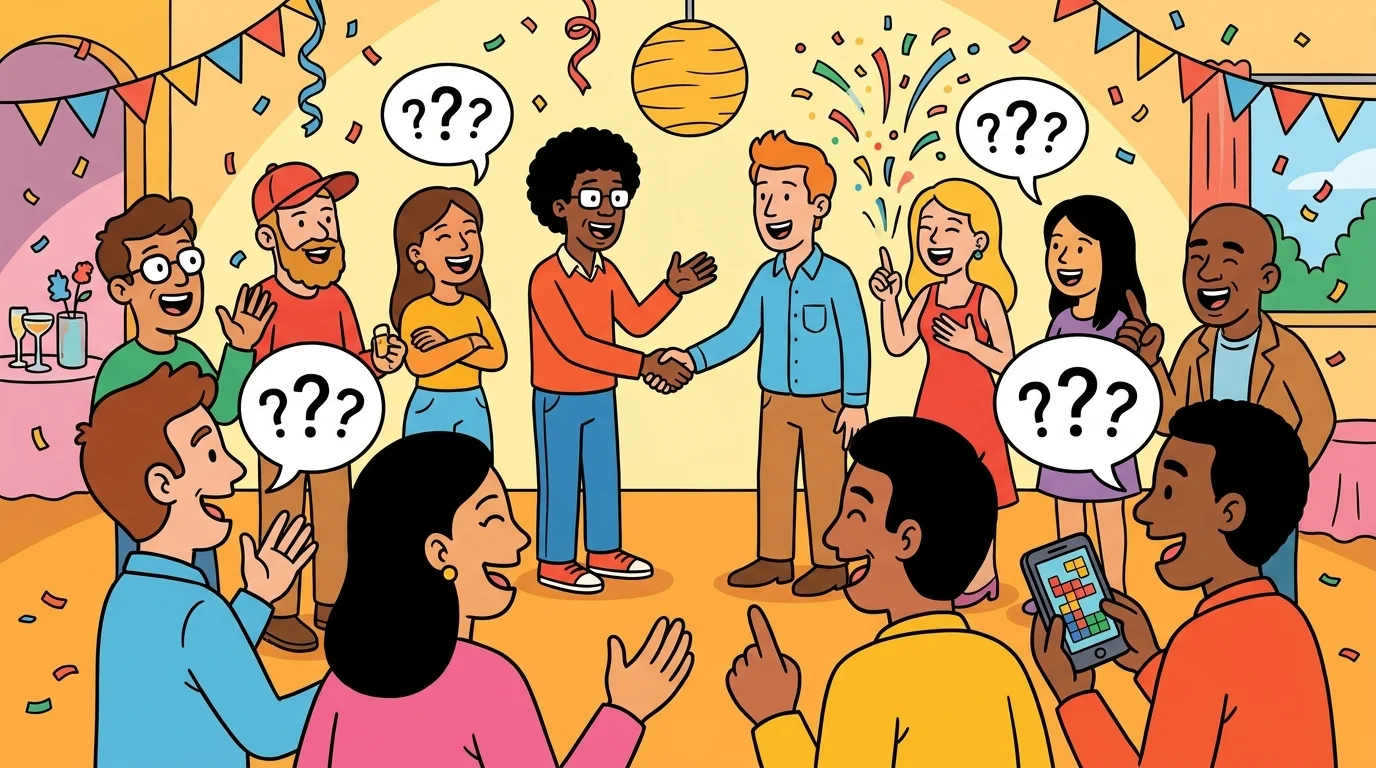
Bad icebreakers are worse than no icebreakers. "Tell us your name and a fun fact" creates awkward silence, forced smiles, and a room full of people who still don't know each other five minutes later.
Good icebreakers, the ones that actually work, create shared experiences, genuine laughter, and natural conversation starters that carry through the rest of the event.
These are the 10 best icebreaker games for new groups in 2026, ranked by how quickly and authentically they get people connecting.
What Makes an Icebreaker Actually Work?
Before the list, here's what separates good icebreakers from the painful ones:
- Low stakes to start, first interaction shouldn't require vulnerability
- Shared experience, everyone does the same thing, nobody watches
- Natural conversation catalyst, the game gives people something to talk about after
- Scalable, works for 5 people or 50
- Fast, under 10 minutes to feel results
Keep these in mind as you read. You'll see why the top-ranked ones work.
#1, Find the Imposter
Best for: Any group, any size, any setting Time to start: Under 60 seconds Cost: Free
Find the Imposter is the single best icebreaker for new groups in 2026, and it's not close. Here's why:
- It gives people something to do together immediately, not something to say about themselves
- Everyone participates every round, nobody watches
- It creates shared memories within the first 5 minutes ("remember when Ahmed said 'it's furry' and we all thought he was talking about a cat but it was Beyoncé?")
- The imposter mechanic builds natural suspicion and banter, the exact social glue new groups need
- It works for groups of 3 to 15 without changing anything
How to run it: Open findtheimposter.com, pick Animals or Food & Drinks (safe, universal categories), play two rounds. By round two, people are calling each other out by name and laughing. Icebreaker achieved.
#2, Two Truths and a Lie (With a Twist)
Best for: Small groups (4–10), professional settings Time: 10–15 minutes Cost: Free
The classic, but with a twist: instead of volunteering facts about yourself, players write them on paper and shuffle. Someone reads a random paper, the group guesses whose it is AND which is the lie.
This removes the performance pressure of the original version while keeping the curiosity element.
Why it works: People are curious about each other's facts, not forced to perform their own personality to a silent room.
#3, Wavelength (App or Physical)
Best for: Thoughtful groups, creative teams Time: 15–20 minutes Cost: Free app or ~$35 physical
One person secretly knows where a target falls on a spectrum (Hot → Cold, Good → Evil). They give a one-word clue and the group guesses the position. The debate about why the clue means that position is the actual game.
Why it works: The disagreements that emerge reveal personalities naturally. "Of course 'teacher' is more authoritative than 'parent'!", suddenly you know a lot about how someone thinks.
#4, Story Chain
Best for: Creative groups, writers, kids Time: 5–10 minutes Cost: Free
One person starts a story with one sentence. The next person adds a sentence. Continue around the circle. The only rule: you cannot end the story.
Why it works: Nobody performs alone for long. The accumulated absurdity creates shared jokes. And creative risk-taking in a low-stakes environment builds psychological safety fast.
#5, Quick Fire Questions (Card Version)
Best for: Professional events, large groups Time: 10 minutes Cost: Free (print questions) or ~$15 for card deck
Prepare 20 unexpected questions on cards. Pass them around. Each person draws and answers in 30 seconds. Questions like: "What's the most useless skill you have?", "What's the last thing you Googled?", "What's a food you pretend to like?"
Why it works: Unusual questions get unusual answers. Unusual answers are memorable and create follow-up conversations.
#6, Human Bingo
Best for: Large groups (20+), conferences, onboarding Time: 15–20 minutes Cost: Free (printed sheets)
Give everyone a bingo card with traits in each square: "Has lived in 3+ countries," "Can say hello in 5 languages," "Has a hidden talent." Players mingle to find people who match each square.
Why it works: Gives introverts a task to accomplish (fill the bingo card) rather than an open-ended social situation. The task removes anxiety; the conversation happens naturally.
#7, Gartic Phone (Online)
Best for: Remote groups, tech-comfortable crowds Time: 15–20 minutes Cost: Free
The digital telephone-drawing game. Someone writes a phrase. The next person draws it. The next person describes the drawing. The next person draws that. Reveal the full chain at the end.
Why it works: The final reveal is always hilarious, and the explanation of what went wrong becomes instant shared history.
#8, The Name Game
Best for: Groups where learning names matters (classrooms, onboarding) Time: 5–10 minutes Cost: Free
First person says their name plus an alliterative adjective ("Adventurous Ahmed"). Each subsequent person repeats everyone before them and adds their own. The group helps each other remember.
Why it works: Names actually stick. And the collaborative memory task creates an immediately collaborative atmosphere.
#9, Would You Rather? (Work-Safe Edition)
Best for: Any group, very quick warmup Time: 5 minutes Cost: Free
Take turns posing "would you rather" dilemmas. The catch: everyone must choose and explain their reasoning in one sentence.
Why it works: People reveal personality through their reasoning. "I'd rather work remotely because I focus better" tells you something real about the person without being invasive.
#10, Silent Line-Up
Best for: Physical groups who need a quick energy boost Time: 5 minutes Cost: Free
Give the group a simple challenge: line up in order of [birthdate / height / how far you traveled to get here] without speaking. Communicate only through gestures and eye contact.
Why it works: Physical problem-solving together builds immediate team identity. The shared confusion and laughter are genuine rather than performed.
Quick Reference Guide
| Icebreaker | Group Size | Remote? | Time | Cost |
|---|---|---|---|---|
| Find the Imposter | 3–15, local or online | ✅ | 5 min | Free |
| Two Truths and a Lie | 4–10 | ✅ | 10 min | Free |
| Wavelength | 4–12 | ✅ | 15 min | Free/€35 |
| Story Chain | 4–15 | ✅ | 5 min | Free |
| Quick Fire Questions | Any | ✅ | 10 min | Free |
| Human Bingo | 20+ | ❌ | 15 min | Free |
| Gartic Phone | 4–12 | ✅ | 15 min | Free |
| The Name Game | 5–20 | ✅ | 5 min | Free |
| Would You Rather | Any | ✅ | 5 min | Free |
| Silent Line-Up | 5–25 | ❌ | 5 min | Free |
Our Recommendation
For most new group situations, start with Find the Imposter, it's free, instant, and creates the shared laughter and memory-making that make every other conversation easier afterward. Then follow up with Two Truths and a Lie or Quick Fire Questions once people are warmed up.
The best icebreaker isn't the cleverest one, it's the one that actually gets people talking to each other naturally. That's the only test that matters.