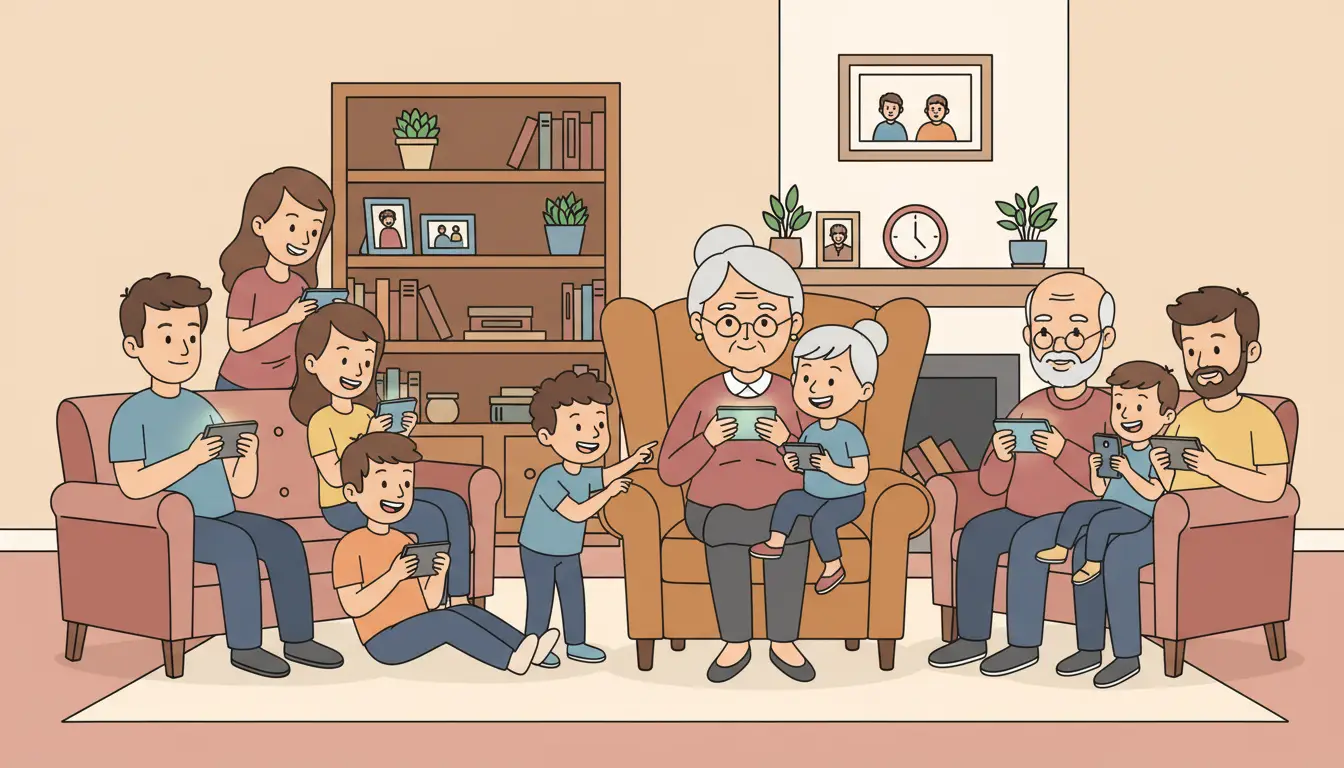
The challenge with most party game lists: they assume everyone playing is in their twenties. Fast-paced reaction games, complex rule sets, tiny text on small screens, games designed for one age group often exclude another.
The best family gathering game is one where a grandmother and a teenage nephew are equally engaged. This list focuses exactly there: games with low barriers, high enjoyment, and no assumption about phone proficiency or physical capability.
What Makes a Game Senior-Friendly?
No time pressure on individual actions. Games where you must respond in 3 seconds exclude anyone who processes information differently.
Simple rule set. If you need more than 2 minutes to explain the rules, the game is too complex for a mixed-age gathering.
No physical requirement. Reaching, sorting quickly, or any sustained physical activity excludes some participants.
Meaningful participation regardless of knowledge. Trivia where younger generations know nothing about the 1960s, and older generations know nothing about recent culture, creates parallel exclusion.
#1 Find the Imposter, Best Senior-Friendly Game
Why it works across all ages:
The core mechanic requires social intelligence, not trivia knowledge or reflexes. You give a clue about a word, watch other people's faces, then discuss and vote on who seems suspicious.
This is not a game of who has the most information. It's a game of who reads people best, and older adults, with decades more experience reading social situations, often excel.
What makes it accessible:
- No time pressure during clue-giving, players take their time
- Categories like "Food," "Animals," and "Countries" are universally accessible
- The discussion phase rewards verbal communication and observation, not quick reflexes
- Simple interface usable on any phone
The unexpected benefit: Watching a grandparent catch the Imposter through pure social observation, before anyone else, creates a family memory that lasts longer than the round.
#2 Codenames (Classic)
Players: 4–12 | Time: 20–30 min | Cost: ~$25 physical / Free browser
Two teams compete to contact their agents based on one-word clues from their Spymaster. All words are visible, no memorization, no hidden information management.
Why seniors enjoy it: The pace is determined by the group, not a timer. Word association is a universal cognitive skill. The Spymaster role rewards broad vocabulary and life experience.
#3 Taboo (Without the Timer)
Players: 4–12 | Time: 20–30 min | Cost: ~$20 physical
Describe a word without using five related "taboo" words. Remove the timer for a senior-friendly version, players have as long as they need. Competitiveness shifts from speed to creativity.
#4 Twenty Questions (No Equipment)
Players: Any | Time: Flexible | Cost: Free
One person thinks of something; others ask yes/no questions to identify it in 20 or fewer. No technology required. Works at any dinner table, in any car, anywhere.
Why it works across ages: Subjects can be tuned to the group, "famous person from the 1970s" is as accessible as "famous person from this year."
#5 Family Trivia (Curated Categories)
Generic trivia fails mixed-age groups. Curated trivia works. Balance categories so knowledge distributes fairly:
- "Family history" questions where grandparents are the experts
- "Current events" where younger members have the advantage
- "World geography" that any generation can answer
- "Family-specific" questions everyone finds interesting
Tips for Running Mixed-Age Game Sessions
Let older players explain their reasoning. In imposter game voting discussions, actively ask for older family members' analysis. Their observations are often the most precise, but they may not volunteer unless asked.
Avoid visible leaderboards. Competitive scoring creates anxiety for some players. Focus on games where the social experience is the reward.
Use categories that cross generations. In Find the Imposter, "Food," "Nature," "Animals," and "Countries" work for every age.
Match round length to group energy. Shorter rounds (10–15 minutes) with breaks are better for sustained mixed-age gatherings than single long sessions.
Frame games as experiences, not competitions. "Let's see how long it takes us to catch the Imposter" is more inclusive than "Let's see who wins."
The Multigenerational Game Night Formula
A session that works for ages 8 to 70:
- Find the Imposter, 2 warm-up rounds with simple categories (Animals, Food)
- Let the older players anchor the discussion, their social observation is often the most accurate
- Curated family trivia, questions that distribute expertise fairly
- Twenty Questions, no equipment, just conversation
This sequence runs 60–90 minutes, requires no equipment purchases, and produces the cross-generational interaction people remember months later.