A game night lives or dies with the host. Great games, great people, and a bad host still equals a flat evening. A mediocre game list with an excellent host? People talk about it for weeks.
This guide covers everything: who to invite, what to play, how to set up, and how to manage the energy so the night never stalls.
Step 1, Build the Right Guest List
The ideal game night group: 6–12 people.
Fewer than 6 and social deduction games feel thin. More than 12 and managing rules explanations becomes a second job.
More importantly: match the energy levels. A group of ultra-competitive players will frustrate casual guests. Know your crowd.
- Competitive group: lean into strategy and deduction
- Casual mixed group: keep games simple, emphasize laughs over winning
- Work colleagues: stick to games where no one gets too personal
- Close friends: almost anything works, lean into the chaos
Rule of thumb: invite people who talk to each other already. Game night amplifies existing social dynamics, it doesn't fix awkward silences.
Step 2, Pick Your Games in Advance
Never decide what to play on the night. You'll spend 20 minutes on your phone looking at options while guests sit awkwardly.
The perfect game night lineup:
- Warm-up game (10–15 min), something simple while people are still arriving and finding seats
- Main game (30–60 min), the centrepiece of the night, your best pick
- Fast rounds game (10–15 min each), something short for the end of the night when energy is high but attention spans are short
Best warm-up: Find the Imposter, low stakes, instant to set up, everyone gets involved immediately without needing to understand complex rules. Share a room code and you're playing within 2 minutes.
Best main games: Codenames, Wavelength, Resistance/Avalon (for committed groups)
Best late-night: Find the Imposter again (rounds are short, competition escalates), or a trivia game with easy categories
Step 3, Set Up the Space
Most hosts underestimate how much the physical setup matters.
Seating:
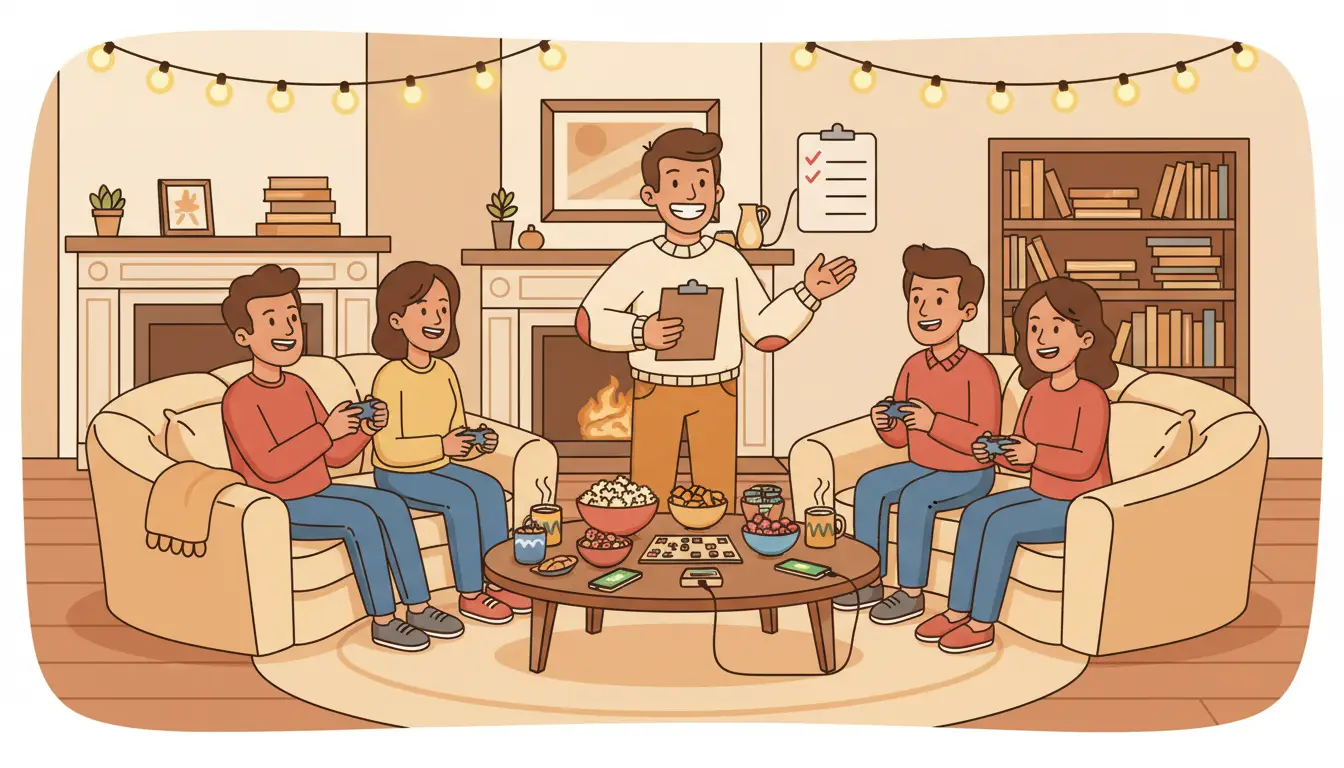
- Everyone should be able to see everyone else's face
- Avoid long thin tables where people can't see the ends
- Round or square arrangements work best for deduction games, you need to watch people's expressions
Lighting:
- Bright enough to read expressions, dim enough to feel like an event
- Avoid harsh overhead lighting, it kills atmosphere
- String lights, floor lamps, or candles on side tables work well
Devices:
- Let everyone know in advance: bring your phone, charged
- Have a power strip and chargers available, two-hour game nights drain batteries
- Test your Wi-Fi password before guests arrive and have it somewhere visible
Food and drinks:
- Finger food only, nothing that requires cutlery while holding a phone
- Set up a drink station they can access themselves so you're not constantly getting up
- Avoid anything with strong smells (the social proximity of game night makes this relevant)
Step 4, Explain Rules Without Boring Everyone
The single biggest game night killer: a 10-minute rules explanation before anyone's touched a card or screen.
The better approach for digital games:
Let the game explain itself. Find the Imposter, for example, tells each player their role on screen. One practice round covers all the edge cases naturally. Don't over-explain.
The better approach for board games:
- Give a 90-second overview: what's the goal, how do you win, what does a turn look like?
- Start playing immediately
- Answer questions as they come up
- Accept that the first round will be rough, that's normal
The goal of rules explanation is just enough to start, not complete understanding before we begin.
Step 5, Manage the Energy Through the Night
The natural arc of a game night:
- First 30 min: Guests are still warming up, slightly reserved
- Middle 60–90 min: Peak energy, people are comfortable, competitive, loud
- Final 30 min: Energy starts to drop, people need shorter games or a wind-down
Read the room and adapt. If a game is dragging, it's okay to call it and switch. A host who forces a dead game to finish is not serving their guests.
How to prevent dead spots:
- Have the next game ready to go before the current one ends
- When energy dips, introduce a competitive short-round game rather than a long complex one
- If a game is going badly, blame the game ("Let's try something else, this one's not landing tonight"), never blame the players
Step 6, The Debrief
The best moments of game night happen after the game ends. The imposter reveal, the terrible Kahoot answer, the unexpected win, these stories have more staying power than the game itself.
As host, your job after each game:
- Replay the funniest moments out loud: "Can we talk about how [name] gave 'cloud' as their clue for 'cheese'?"
- Don't rush immediately into the next game
- Let the energy from the last game carry into the transition
This is where the memory of the night gets made.
Game Night Host Checklist
Before guests arrive:
- Games picked and ready (no deciding on the night)
- Room set up in a circle or square seating arrangement
- Wi-Fi password visible somewhere
- Chargers and power strip available
- Finger food and drinks ready to self-serve
- First game loaded (e.g. Find the Imposter room created)
During the night:
- Keep rules explanations under 2 minutes
- Read the room, switch games if energy drops
- Replay the best moments after each round
- Don't let one person dominate conversation between rounds
The One-Game Game Night
If you're hosting for the first time or just want simplicity, run the entire night on Find the Imposter.
Create a room, set a category, play 8–10 rounds. Change the category between every 2–3 rounds to keep it fresh (Food → Movies → Countries → Sports). Competitive players naturally emerge, quieter players find their voice, and the evening generates its own energy without you managing much at all.