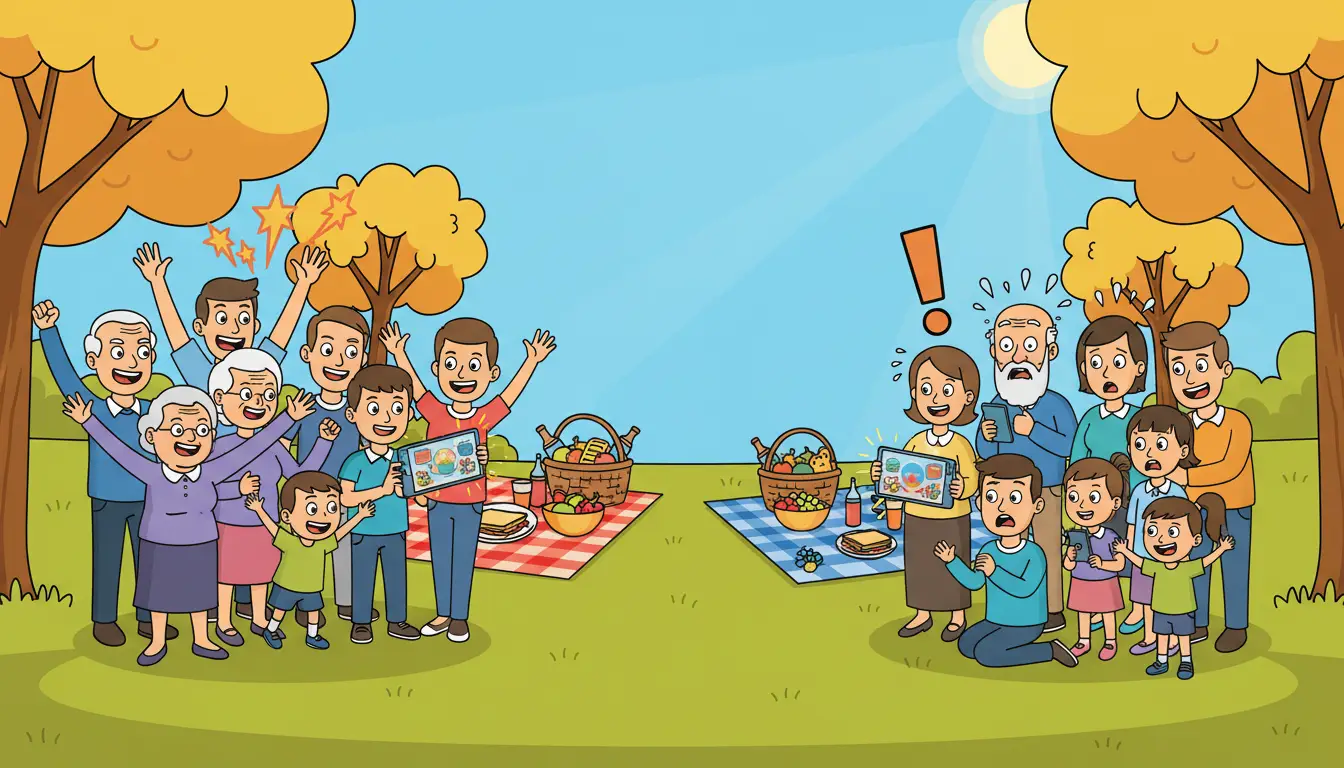
Family reunions have a unique challenge: you're trying to entertain a 12-year-old, a 40-year-old, and a 70-year-old at the same time, with a group size that changes as people arrive and leave throughout the day.
Most game recommendations fail here. Board games need the full group at a table simultaneously. Sports activities exclude people with mobility issues. Trivia is only fun if everyone has similar knowledge.
What works: simple social games that scale up and down naturally.
What Makes a Game Work at a Family Reunion
Before the list, here's the filter:
Scales across group sizes: You need games that work when 8 people are playing and still work when that becomes 20 an hour later.
No age barrier: If a game requires quick reflexes, a strong reading level, or specific pop culture knowledge, you've excluded someone.
Short enough to drop in and out of: Family reunions aren't structured events. People come and go, kids need feeding, grandparents need resting. The best games accommodate this.
Doesn't require equipment: You're likely at a venue without a game closet. The equipment should be phones.
#1 Find the Imposter, Best Family Reunion Game
Players: 3–15 per room | Time: 10–15 min per round | Cost: Free
Find the Imposter works better than almost any board or card game at a family reunion because it flexes naturally around the chaos of a family event.
Why it works:
- Players can join mid-event, if Uncle Hassan arrives an hour late, he can join the next round
- Works on every phone without downloads
- The categories are broad enough for any age (Animals, Food, Countries, Sports)
- Rounds end naturally at 10–15 minutes, not when everyone finally finishes a board game
Family reunion tips:
Split into two rooms if you have 20+ people. Create two separate game rooms, one for kids/teens, one for adults. Let them play simultaneously and compare results between rounds. First room to catch their Imposter three times wins a round.
Use categories that spark family conversation. "Countries" starts conversations about travel and heritage. "Food" gets everyone talking about family recipes. These categories are secretly conversation starters disguised as game rounds.
The grandparent advantage. Older players often win at social deduction because they're better at reading people and have less fear of confrontation. Don't assume it'll go over their heads, often they're the first to catch the Imposter.
#2 Scavenger Hunt (Custom for the Family)
Players: Any | Time: 30–60 min | Cost: Free
Create a list of items or photos to find at the reunion venue. Works especially well with kids and teens running around, but adults join in surprisingly enthusiastically.
Digital version: Create a shared album in Google Photos. Everyone submits photos of items on the list. The family votes on the best photo for each category.
#3 Family Feud Style Quiz
Players: Any | Time: 20–30 min | Cost: Free
Use Kahoot to build a quiz around the family: "What's Grandma's favourite meal?", "Who went on the most trips this year?", "Who would win in a cooking competition?" The personal angle makes trivia work when general knowledge trivia would split the group.
Requires 20–30 minutes of prep work from someone in the family.
#4 Heads Up! (Relay Style)
Players: 6–20 | Time: 15–25 min | Cost: ~$1 app
Classic phone charades game. Works especially well as a relay, family members take turns and the running total score determines which generation wins the round. Grandparents vs parents vs kids makes it immediately competitive.
#5 Two Truths and a Lie (Family Edition)
Players: 6–25 | Time: 20–30 min | Cost: Free
Works especially well at family reunions where some relatives haven't seen each other in years. The surprise factor of learning a fact about a family member you haven't talked to in two years produces exactly the right kind of moment.
Variation: Make it about family history, "Two things about our family history are true, one is false." Forces the elder family members to be the experts.
Managing Game Time at a Reunion
The difference between a great and a mediocre family reunion game session:
Have one person as the game host. Someone needs to make decisions, which game next, who's playing, how long a round runs. If it's everyone's decision, nothing happens.
Start games before everyone's ready. Waiting for 100% attendance before starting means never starting. Begin with whoever's there; others join as they arrive.
Run games between meals, not during. The best window for structured games is 30–60 minutes after eating, when everyone's still at the venue but before the sitting-around-talking phase kicks in.
Keep a prize optional and lighthearted. A silly trophy, a family title ("Best Detective of 2026"), or a running joke prize, something to compete for without real stakes.
The Full Day Schedule (Template)
| Time | Activity |
|---|---|
| Arrival + first hour | Find the Imposter warm-up (casual, people joining as they arrive) |
| Before lunch | Family Feud quiz, personal questions, grandparents are the stars |
| After lunch | Find the Imposter competitive rounds, adults vs teens split |
| Mid-afternoon | Scavenger hunt (kids-led) + Two Truths for adults |
| Evening | Final Find the Imposter championship round, all ages |
The One Thing That Always Works
If you have zero time to plan and need something that works right now: open Find the Imposter, create a room, and call it the "Family Championship." Pick the category "Animals" for the first round, it's universal, funny, and generates surprisingly creative clues from all ages.
The name "Family Championship" does more work than any complex game design.